Stop Measuring Time
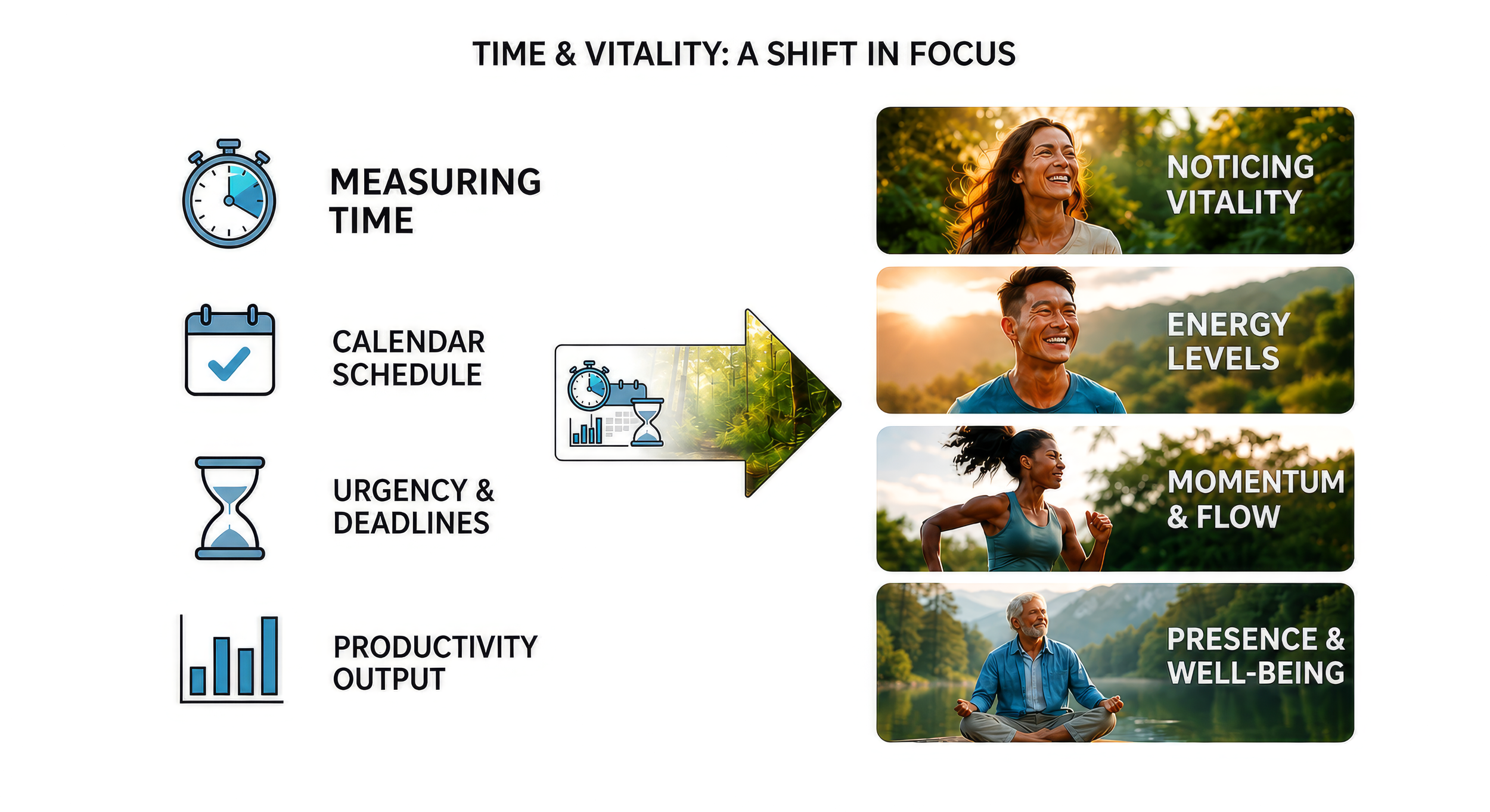
MINDSET SWAPS: from measuring time to noticing vitality…
You’ve likely heard the adage: what gets measured gets done?
And, this is a question I’ve been thinking about lately: What if we are measuring the wrong thing?
Modern work is obsessed with time. We track hours, calendars, productivity metrics, deadlines, response rates, utilization percentages. We speak proudly of being “booked solid” or “crazy busy,” as though exhaustion itself has become evidence of value. I’m guilty. My hand is raised. I still want the perfect planner, a paper calendar, and an A+ in productivity.
But I’m not sure time is the real issue anymore.
I think many people are suffering from something deeper: the slow erosion of vitality.
You can see it in the way people move through their days — toggling endlessly between screens and responsibilities, answering messages while half-listening to conversations, rushing from one obligation to another with almost no space to absorb what is actually happening. Many leaders are technically productive while feeling emotionally threadbare.
We have become extraordinarily efficient at spending ourselves.
And yet, when I think about the healthiest leaders and organizations I know, what distinguishes them is not time management. It is aliveness.
There is energy in the room. Curiosity. Humor. Presence. People feel connected to what they are building together. They are tired sometimes, certainly, but that’s different from being chronically depleted. Their work contains some sense of meaning, contribution, and movement.
Vitality matters because people do not create their best work from exhaustion. Innovation requires energy. So does patience, creativity, collaboration, and wise decision-making. Even kindness becomes harder when people are emotionally overextended.
But unlike time, vitality is rarely measured. Organizations track performance relentlessly while paying far less attention to the conditions that either drain or sustain human energy.
What restores people?
What depletes them?
What creates momentum rather than merely pressure?
These are leadership questions, too.
In my work with teams, I often notice that energy is deeply relational. Environments shaped by trust, clarity, and genuine connection tend to generate resilience. Environments shaped by chronic ambiguity, guarded communication, or performative urgency slowly wear people down.
Not every form of exhaustion can be solved with a vacation or a wellness initiative. Sometimes what people need is not less work, but more meaning. More honesty. More autonomy. More beauty. More moments where they feel fully present inside their own lives.
This is one reason reflection matters. Without reflection, we lose the ability to notice what is happening to us. We become reactive instead of intentional, efficient instead of aware.
Perhaps this is why so many people long for experiences that restore their sense of perspective: walking outdoors, meaningful conversation, silence, art, prayer, music, travel, creativity. These moments reconnect us to ourselves beneath the noise of constant output. Recently, I enjoyed an interview by the New York Times with travel expert Rick Steves. He noted three types of travelers: tourists, who are trying to escape their lives by going elsewhere, travelers who want to immerse themselves as a temporary local in a culture, and pilgrims who set out with the intention of being transformed by their journey and by gaining a perspective on their homeland from a distance. We need more pilgrimages in our lives and in our work.
I am not suggesting that organizations abandon accountability or ambition. Meaningful work requires discipline. But sustainable leadership asks something more nuanced than endless productivity. It asks whether people can remain fully human while doing the work.
Maybe the goal is not simply to manage time more effectively.
Maybe the deeper invitation is to pay attention to what allows us to remain alive within it.
Mindset swaps: from measuring time to noticing vitality…
WHAT IF…
Instead of measuring worth by how full the calendar is, try noticing whether the work still leaves room for presence, perspective, and sense of self.
Instead of treating “crazy busy” as evidence of importance, try asking whether urgency is creating momentum—or simply draining energy.
Instead of focusing only on productivity, deadlines, and output, try paying attention to what restores curiosity, creativity, patience, and wise decision-making.
Instead of assuming exhaustion is just the cost of meaningful work, try distinguishing between temporary tiredness and the deeper erosion of vitality.
Instead of solving depletion only with time off or wellness initiatives, try looking at the conditions that sustain people: trust, clarity, honesty, autonomy, connection, beauty, and meaning.
Instead of asking only, “How can we get more done?”try asking, “What helps us remain fully human while doing the work?”
If your calendar is full but your energy feels thin, this is a good moment to pause and ask a better question:
What would help you, your team, or your organization feel more alive in the work ahead?
I invite you to schedule a conversation with me so we can look together at what is draining vitality, what might restore it, and what kind of leadership support could help you move forward with more presence, meaning, and sustainable energy.
Let’s stop only measuring time — and begin making room for the vitality that makes meaningful work possible. If you’d like to consider these questions further with me, let’s have a chat and dive a little deeper…
You’re just a click away and a 1 brief intake form away from beginning a whole new way of working!